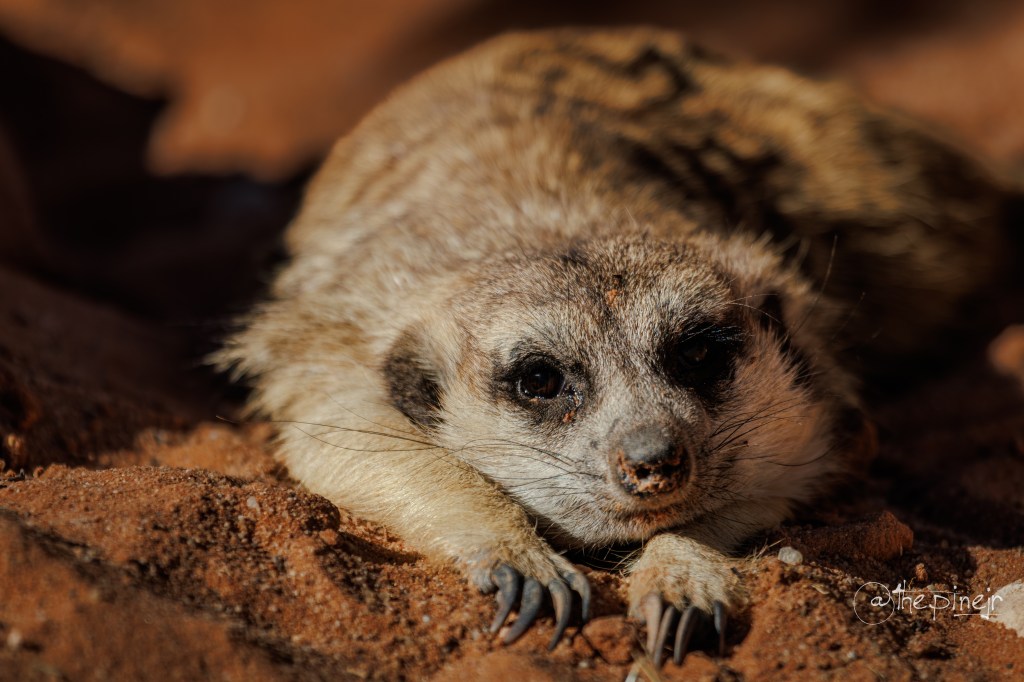
Not Your Usual Caffeine-Induced Rant or Leopard Love Story
Today’s story doesn’t involve caffeine-fuelled existentialism, or me having another breakdown over a spotted cat with commitment issues somewhere in Pilanesberg. No, this one’s different. It’s about a place. A real place. A story. And dare I say it—an actual win for conservation. Shocking, I know.
This is the story of the Kalahari Trails Meerkat Sanctuary.
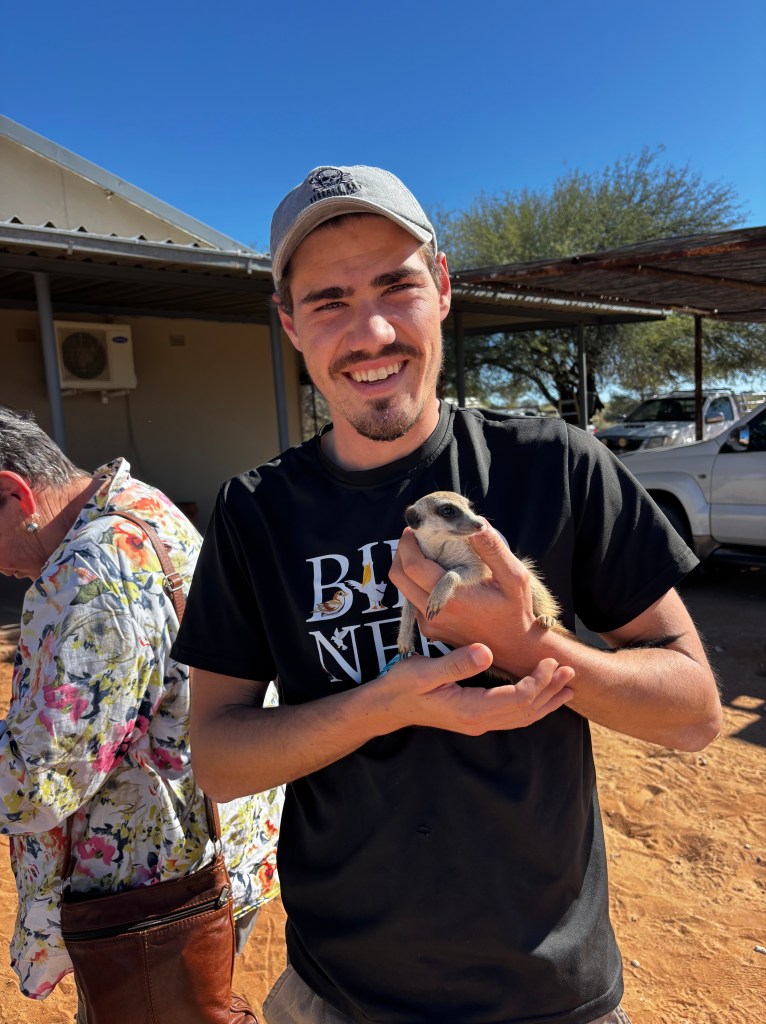
Me being a tourist holding a Meerkat at Kalahari Trails
Now before you roll your eyes and imagine a tiny enclosure full of obese meerkats being spoon-fed while tourists pose with them for Instagram likes—believe me, I was right there with you. I have a massive issue with many so-called “sanctuaries.” Some of them—names withheld for legal and sanity reasons—run more like low-budget zoos. Tiny cages, big promises, and absolutely zero intention of ever rehabilitating anything. Especially not when the animal in question is profitable. And let’s not even get started on those lion facilities. You know the ones. The ones that breed lions under the pretence of conservation, only for them to wind up as targets in some twisted canned hunting setup. Grim stuff.
While we’re on the topic of real heroes: there was a mass vulture poisoning incident recently in Kruger, and organisations like the Endangered Wildlife Trust and Moholoholo went above and beyond to save as many as they could. Moholoholo, I should add, is not part of the shady group I mentioned earlier. They do proper work. The kind that gives you hope.
But back to the Kalahari. And back to the meerkats.
The story starts in 2023. Family holiday to the Kgalagadi. Cue me falling head over veldskoene in love with the place—red dunes, dry air, that spiritual kind of silence you only get in the desert. On our way out of the park, someone (my mother, naturally) suggested we stop at the Kalahari Trails Meerkat Sanctuary since, believe it or not, we hadn’t seen a single meerkat in the wild. I was not keen. I work in this industry. I know what captivity does to animals. I wasn’t about to support some puffed-up petting zoo with a meerkat mascot named Kevin in a waistcoat.
But fate had other plans. In the form of a nasty puncture to the right front tyre.
The first safe place to pull over? You guessed it. Kalahari Trails Meerkat Sanctuary. As if fate herself had orchestrated it. Lovely lady, fate. Chaotic. But lovely.
Now initially, we were too preoccupied with the tyre to notice the meerkats. The staff were incredibly helpful. Even the owner himself—Richard Rasa Phillips (fascinating guy, go read up on him)—helped us out with a hydraulic jack. And while we were busy playing tyre roulette, my mother had already wandered off and acquired a meerkat. Like one does.
So naturally, we stayed for coffee. And malva pudding. Because apparently that’s how these things go.
And that’s when the walls started to come down. We started chatting with Mareli van der Berg, the guide on the property, who introduced us to the residents. One in particular stood out—Paddington. A young meerkat with a rough start in life. I can’t recall the full story of how he ended up there, but I do remember feeling that tightness in the chest you get when something sad is delivered so casually it hits harder. And with that, we left for Pretoria. Case closed. Or so I thought.
Fast forward to 2025.
After the grand overlanding trip through Namibia and another round through the Kgalagadi, there was no way I was skipping a return visit. And wow, what a difference two years make.
The sanctuary has undergone serious upgrades. Better facilities, improved accommodation, and a sense of momentum. Things were clearly happening.
But what hit me most was Paddington.
The name had stuck with me—don’t ask why. Maybe I just have a thing for underdog stories. When I asked what had become of him, I didn’t expect the answer I got: Paddington is now a free meerkat. Wild. With a family. Living out on the property like a proper desert-dwelling dad, doing what meerkats are supposed to do—digging, guarding, foraging, and protecting his clan.
He was raised, rewilded, and released. And now he’s thriving.
Cue the lump in the throat. Or, depending on your level of denial, someone chopping onions nearby.
And this, dear readers, is the point.
This is one of the rare sanctuaries that actually deserves the title. They’re doing it right. They’re giving animals a second chance. And they’re doing it in a place that’s not too far from Twee Rivieren Gate—which, by the way, makes it a perfect stop if you’re heading in or out of the Kgalagadi or can’t get park accommodation.
They also run some fantastic activities—one of the highlights being a scorpion-hunting session with the meerkats, where human guides help the meerkats learn to fend for themselves. That’s the kind of tourist interaction I can get behind. It helps fund the place, it helps the animals, and it leaves you with one of those rare feelings these days: like maybe, just maybe, we’re not messing everything up.
I’ll drop their website link at the end so you can check them out, book a stay, or just read more about what they’re doing.
There are a couple more of these small conservation wins I want to share with you soon. But for now—here’s to Paddington. To the real sanctuaries. And to the small victories that give us hope.
 Wildlife Beyond the Lens