
Private sightings, full bellies, and the chaos of growing up in the bush
I’m writing this from the FNB lounge at Cape Town Airport — which, as far as habitats go, ranks somewhere between a dentist’s waiting room and a government queue. The coffee tastes faintly of disappointment, the air smells like recycled ambition, and the only roars come from delayed passengers. Still, it’s as good a place as any to reflect on the last few months with a pride of lions that made the bush feel alive in a way no sterile airport ever could. Also — in case you somehow missed it — yes, I posted the video earlier this week. Go watch it. Preferably before your latte gets cold.
It’s funny how these stories start. You’d think “I was pinned between an elephant, a rhino, and a fire” would be an exaggeration — it isn’t. To the west, a bull elephant convinced the world revolved around his mood. To the east, a white rhino pacing like a man who’d just remembered he left the stove on. And to complete the trifecta, the faint tracks of a lioness and her three cubs — the sort of family unit that makes even the most experienced guide reconsider their life choices.
We were on foot, which is the bush equivalent of being invited to a gunfight with a butter knife. The wind shifted, the fire crackled, and for a brief moment I was certain this was how it all ended — a puff of smoke and a footnote in someone’s ranger manual titled “What Not To Do.” But somehow, luck — or perhaps the lioness’s better judgment — spared us. She melted past without a sound, firelight flickering across her flank. A few heartbeats later, silence. We called it an encounter. The elephant, I’m sure, called it Tuesday.
A year later, I found myself back in the Pilanesberg — the same sun, the same dust, but a different sort of anticipation. My first lions on a kill at Black Rhino Reserve. The Western Pride, back when they were still one unit and not yet the fragmented coalition soap opera they’d become. I set off, heart racing, camera ready, completely unaware that this was the beginning of a year that would redefine my understanding of “lucky sightings.”

That morning was all adrenaline and awe; that afternoon, fate introduced me to the Eastern Pride — just the lioness and her cubs. No drama, no roaring males, just a family quietly existing in the golden light. Looking back, that was the real start.
Over the months that followed, the Eastern Pride became something of a running theme. We saw them far more often than the video could ever show, though half those moments never made it past the camera bag — sometimes, you simply stop filming and let the bush happen to you. For nearly two weeks they held court along Thabo’s Loop — hence the affectionate nickname, the Thabo’s Loop Pride. They did what lions do best: nothing. Magnificently, unapologetically nothing. I’d visit every day, hoping for drama, and instead find them stacked in the shade like furry sandbags, looking deeply offended by the concept of effort.
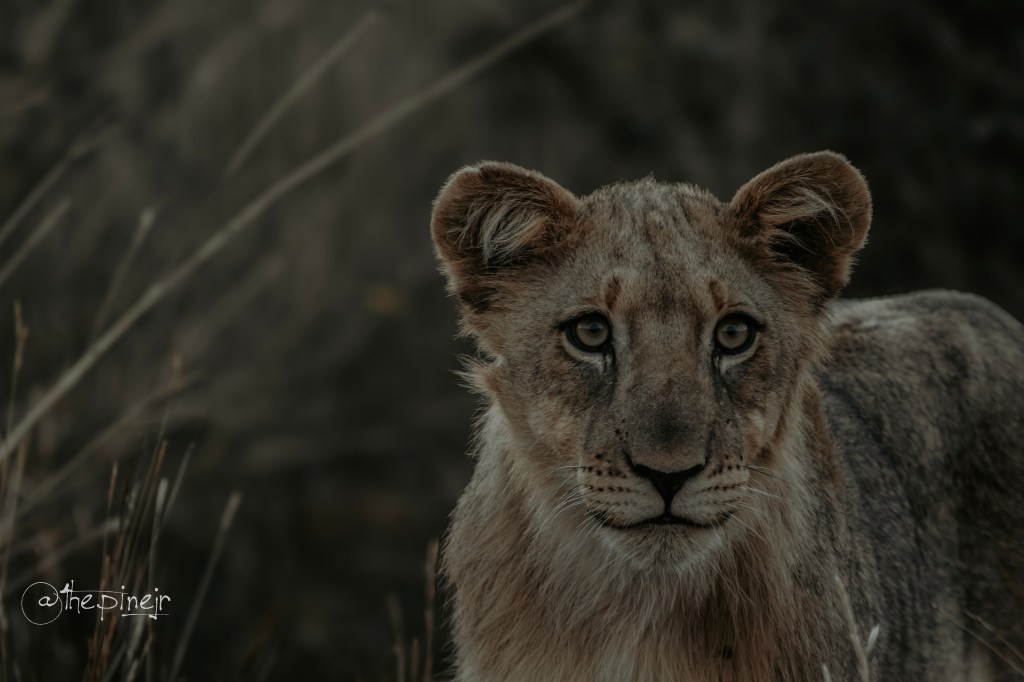
Their personalities were unmistakable. The cubs, all curiosity and clumsy arrogance; the mother, calm but firm; the sub-adults, half-grown troublemakers testing their boundaries. Watching them was like observing a family sitcom — adorable chaos meets Darwinian reality. The young male, particularly, strutted about with all the misplaced confidence of a teenager who just discovered biceps. Testosterone, ladies and gentlemen, is a wonderful thing.
Then there was Mala Pan — another one of their favourite haunts, and a scene of some of my fondest (and most grotesque) memories. After gorging themselves on a wildebeest carcass for what felt like a week straight, one young lion approached the water to drink… and promptly vomited. It was poetic, in the way a hangover might be poetic to someone else. The smell was biblical, the noise unforgettable, and yet, I couldn’t stop laughing. They’d eaten themselves into immobility, emerging from the carcass only for sustenance, mischief, and perhaps to briefly reconsider their life choices.
Of course, lions are the undisputed masters of unpredictability. Just when you start thinking you’ve got them figured out — their favourite spots, their routes, their schedules — they vanish. Days, sometimes weeks. Ghosts with stomachs. And just as you start to think they’ve moved territories entirely, they reappear in the most inconvenient light, looking as if they’d been there all along. From Pannetjies to the shepherd’s trees on Klippiesberg , they had the unnerving habit of showing up exactly where you weren’t looking. Sometimes under a tree very close to the unfenced drink stops we used just to make life more entertaining when it really did not need to be.
Then came the inevitable changes. The pride male — closely related, but not the father of the cubs — was relocated in early October. Ten days later, three new males were seen lounging across the riverbed, each one with the expression of someone who’s just discovered free real estate. Territory was marked, vocals carried through the night, and the entire landscape shifted almost overnight. The sound of roaring lions has a way of turning familiar places into theatres of uncertainty.
At that exact time — on the other side of the concession , I found the lioness again with her cubs tucked under a shepherd’s tree — leaner now, more cautious, but still fiercely present. Soon after, they disappeared once more — for a final time never to be seen on Black Rhino again, only to resurface near Malatse Dam, before eventually returning to Kwa Maritane — the same patch of earth where I’d first seen them as tiny six-week-old cubs, driven my way by fire. There’s a kind of poetry in that — full circle, dust to dust, roar to silence.
And then, the latest chapter. On the 11th of September this year, near Kwa Maritane, I saw the young male again — the same cub I’d photographed months ago, now all muscle and confidence. He and the pride attempted a wildebeest hunt. It failed spectacularly, of course. But that’s the bush — sometimes you win, sometimes you learn, and sometimes you miss dinner entirely.

Watching the Eastern Pride has been about more than sightings. It’s been about connection — about chaos, growth, and the absurd beauty of nature teaching its own lessons. You go out looking for lions and end up finding perspective. It’s far less photogenic, yes, but far more important.
 Wildlife Beyond the Lens