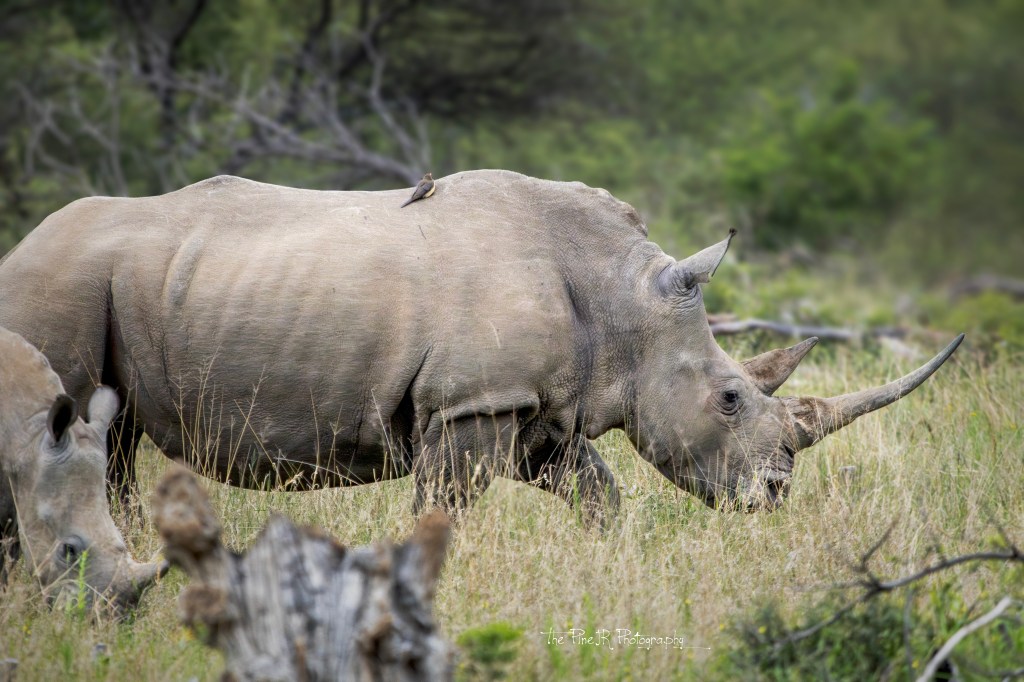
The Rhino Doesn’t Think It’s the Centre of the World — It Simply Can’t Imagine That It Isn’t
A while ago we touched on the uncomfortable idea that all mammals are the same — including us. It’s a series I’ve been building quietly, piece by piece. Not because it’s easy, but because it isn’t. It requires holding a mirror up and not immediately smashing it. It means touching the corners of your own mind that you normally keep locked, labelled “legal disclaimer,” and filed under “not today.”
The framework is simple. Observations. Encounters. Personal experiences. People we know. People we were. The animals are just the delivery system.
Months ago I wrote about the zebra — jealousy dressed in stripes — and I said that when I found the animal that encapsulates existential narcissism, I would write home about it.
It took time.
Nothing ticked all the boxes.
But one animal ticked ninety percent.
The white rhino.
Not narcissistic in the Instagram sense. Not preening. Not posing. Not curating angles.
Existentially narcissistic.
There’s a difference.
A white rhino has presence the way gravity has presence. Massive. Undeniable. Structurally inconvenient. It doesn’t intend to dominate the landscape. It simply cannot conceive of a world that doesn’t rearrange itself around its bulk.
It is not evil.
It is not malicious.
It is spectacularly content with its own centrality.
This morning, after good rain, the bush was still carrying that damp silence that makes every sound feel important. I was working in one of those settings that makes you quietly grateful you didn’t end up in a cubicle. A squirrel began alarming in the distance — sharp, frantic. Birds lifted in nervous waves.
Leopard, I thought.
And because I am pathologically obsessed with leopards, I grabbed cameras before common sense could intervene.
It wasn’t a leopard.
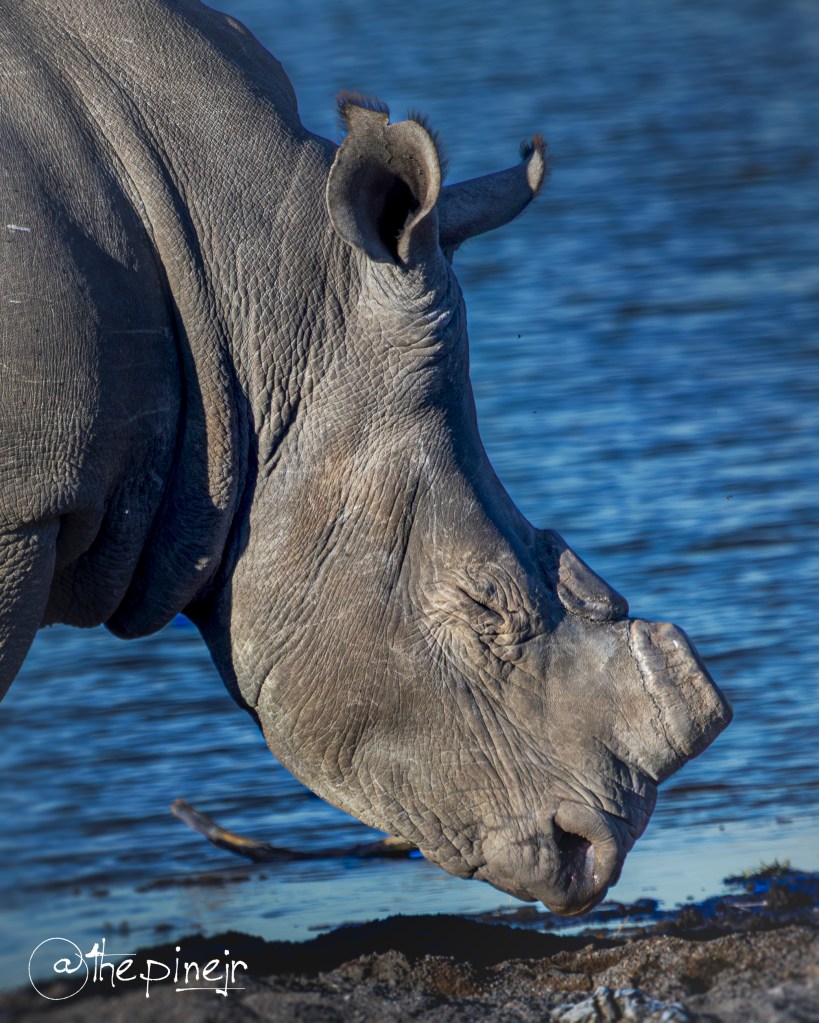
It was a white rhino bull at the waterhole.
Now, rhinos see badly. That’s not metaphorical — that’s biological. Their eyesight is poor, their perception narrow, their understanding of space largely immediate and practical. He drank for a while before realising I was there. And when he did react, it wasn’t curiosity. It wasn’t assessment.
It was force.
A short charge. At nothing, really. At movement. At a suggestion of presence. Moments after I’d already stepped away.
He wasn’t responding to me.
He was responding to disruption.
And that’s when it clicked.
Rhinos take space as appreciation. Humans do something similar. We confuse proximity, longevity, and noise with relevance.
“I was there once.”
“I was involved.”
“I remember how it started.”
As if history is a mortgage on the present.
There are people who believe that because they once occupied a chapter of your life, they retain editorial rights over the sequel. They mistake participation for ownership. Contribution for authorship. They were present at the foundation, so they believe every new floor is somehow built in their honour.
Success is not measured by who stood near you once.
It’s measured by whether you can stand by yourself now.
But that doesn’t stop the peripheral characters from narrating your achievements as if they still hold the pen.
Rhinos do something similar with space. They remember where something happened, not why. A tree becomes significant because something once startled them there. A clearing becomes “theirs” because they stood in it during a season when it mattered.
Memory without context hardens into entitlement.
There’s a white rhino bull in Black Rhino Game Reserve we call Old Hannibal. Number 82. In some areas he’s calm, almost indifferent. In others, he’s volatile. Reactive. Aggressive beyond reason.
I won’t pretend to know what shaped him in those patches of bush. Trauma leaves impressions even in animals. But what fascinates me is how selectively memory directs behaviour. Certain places ignite something. Others don’t.
Humans do this beautifully.
We remember events vividly — but selectively.
And almost always from the safest possible distance from responsibility.
That’s the part that matters.
When someone is absent, they are spared consequence. They avoid nuance. They are not required to adapt their version of events to new information. Memory hardens when it is never challenged by reality. Presence forces correction. Absence allows mythology.
The absent don’t remember events.
They remember the version where they were right, important, or wronged.
Distance turns opinion into fact.
Absence is fertile ground for certainty.
The further someone stands from the work, the clearer their opinions become.
Those who didn’t carry it remember it best — because nothing ever weighed on them.
I no longer argue with animals that charge their own memories.
Because runners don’t negotiate.
They escalate.
When something moves beyond a rhino’s understanding, it responds with force, not curiosity. It does not step back and reassess the clearing. It assumes provocation. It assumes intrusion.
Humans do the same.
Control masquerades as concern.
Involvement masquerades as entitlement.
Unsolicited advice delivered with the aggression of moral ownership. Words put in your mouth. Responsibilities assigned to you by people who never carried the weight of them. People who attempt to dictate your narrative because they once featured in an earlier draft.
The rhino does not ask if it still belongs in the clearing.
It arrives as if it never left.
Any objection is treated as challenge.
And when the clearing has changed — when the grass is shorter, the paths are different, and the animals present no longer recognise its authority — the rhino does not reflect.
It changes the memory.
This is not confidence.
It is bulk without awareness.
It is weight without reflection.
It is certainty without proximity.
And that is a dangerous combination in both bush and boardroom.
The most profound realisation for me this year came from that short, half-blind charge at the waterhole:
He who is absent always seems to have the best recollection of events.
Because absence spares consequence.
Presence forces humility.
The one who stayed had to adapt. The one who left preserved the version where they were central.
Some creatures mistake history for ownership.
Not every animal that remembers the path still belongs on it.
And perhaps the most liberating thought of 2025 for me is this:
The sun still rises for everyone — but not everyone gets to decide where I stand when it does.
I prefer to be in the sun.
Not arguing with bulk.
Not negotiating with memory.
Not rearranging myself around something that never learned to see properly in the first place.
All mammals are the same.
Some just happen to weigh two and a half tons.
 Wildlife Beyond the Lens