Ethics, Principles, and Why “Because I Said So” Is Not Actually a Moral Philosophy
Here is a simple question.
Someone asks you to do something, and you don’t agree with it.
Do you do it?
If your immediate answer was no, congratulations. You have apparently discovered the revolutionary concept of having principles.
Unfortunately, it is not quite that simple.
Because what if refusing makes you difficult? What if saying no is considered disrespectful? What if the person asking you believes they are completely justified? What if there is a policy saying you should do it? What if the policy itself is ridiculous?
And, most importantly, what if doing what you are told goes against what you believe is right?
As always, I promise there is a point to all of this.
Eventually.
I recently read, and then reread, someone’s rather interesting take on ethics and what the world looks like according to Mr Morals himself. Which, incidentally, is an incredibly easy thing to write when you are sitting comfortably somewhere contemplating the philosophical structure of the universe rather than trying to apply it to real life.
I do, of course, see the irony.
Anyway, this was not some enormous stringy piece of cheese about legal ethics or how to behave while attending a royal banquet without accidentally putting your fork in the wrong place. No, thankfully, it was actually interesting enough that I managed to finish it.
One section in particular stood out to me:
“The best guides I’ve worked with have never been the ones who simply knew the regulations. They were the ones who had developed their own internal compass. They didn’t do the right thing because someone might catch them. They did the right thing because they believed it was the right thing to do.
And perhaps that’s one of the quiet truths about our profession.
Guests will probably never remember how close you were to the lion.
They’ll never know whether you could have squeezed another five metres out of the sighting. But the wildlife will.
Every decision we make leaves some kind of footprint, even if nobody else notices it.”
And then came the invitation:
“I’d be interested to hear your thoughts.”
Well.
Here they are.
What Exactly Is “The Right Thing”?
What is the right thing?
Seriously.
Is there some enormous celestial spreadsheet somewhere that determines whether an action is morally acceptable?
Because if there is, I’d quite like a copy.
The problem with ethics is that everyone seems to think theirs is the universal version.
My ethical compass points one way.
Yours might point another.
Someone else’s might have been manufactured in China and is pointing directly at the nearest KFC.
We are human beings. We interpret situations differently. We have different experiences, different values, different cultures, different priorities and, occasionally, completely different levels of common sense.
And this is where I think society has become slightly confused.
We have somehow reached a point where people believe that being right gives them permission to publicly destroy someone else.
Social media has become particularly brilliant at this.
We now have an army of white collar whistleblowers sitting behind keyboards, armed with screenshots, outrage and an astonishing amount of confidence, publicly crucifying guides who are simply trying to do the best they can for their guests.
Suddenly someone is five metres too close to a cheetah and the Facebook jury has assembled.
GUILTY.
The guide is apparently a disgrace to conservation.
His career should be over.
His family should probably move.
Someone will inevitably type, “I would never do that,” before posting a photograph of themselves standing next to a lion that was probably taken at approximately the distance of the International Space Station.
And this is where things get interesting.
Because ethics seem to become particularly important when someone else has been caught.
When nobody is watching, however, the moral high ground becomes considerably less populated.
So What Do You Do When Nobody Is Watching?
This is, for me, the actual question.
What do you do when nobody knows?
When there is no one around.
No camera.
No social media audience.
No scrutinising higher authority.
No policy.
No one standing behind you waiting to congratulate you for making the correct decision.
What do you do then?
Because surely that is where ethics actually live.
Not in the rulebook.
Not in the Facebook comments.
Not in the carefully constructed LinkedIn post explaining how deeply committed you are to conservation.
They exist in the little decisions nobody sees.
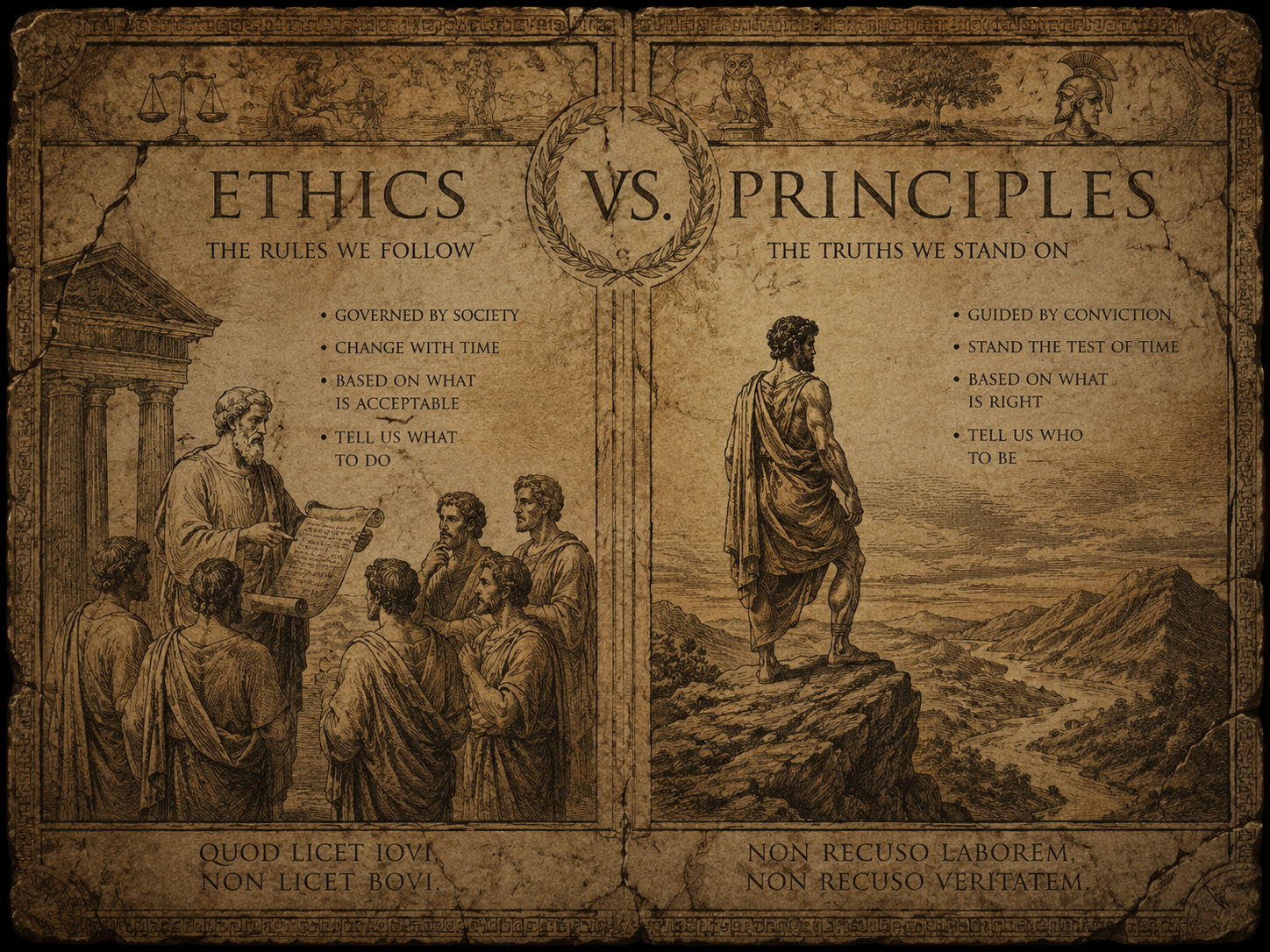
And this is where I think principles become far more important than policies.
Policies can tell you what you must do.
Ethics can tell you what you should do.
But principles?
Principles tell you what you will not do, even when doing it would be easier.
That distinction matters.
Principles
Principles are the invisible barrier.
They are the thing that stops you from bending when there is nothing physically stopping you.
They are what makes you stand up for yourself when everyone else thinks you should simply shut up and comply.
They are also what makes you question yourself when nobody else is there to do it for you.
And personally, principles are one of the biggest deciding factors in whether something is worth my time.
You can hammer me all you want.
You can disagree with me.
You can tell me I’m difficult.
You can tell me I’m stubborn.
You can even tell me that I am completely and spectacularly wrong.
But if something becomes a matter of principle, I will fight it until the cows come home, realise they have accidentally joined the argument, and leave again.
Because sometimes it isn’t about winning.
It is about refusing to compromise something you fundamentally believe in.
The Safari Example
Let’s take something simple.
A cheetah is close to your vehicle.
There might be a policy telling you what distance you should maintain.
Fine.
But what happens when the situation doesn’t fit neatly into the policy?
Perhaps the cheetah has walked towards the vehicle.
Perhaps there is no other vehicle around.
Perhaps the animal is completely relaxed.
Perhaps there are no bystanders.
Perhaps moving the vehicle would actually cause more disturbance than simply remaining stationary.
The policy might say one thing.
My principle is much simpler.
Did my actions negatively impact the animal?
No?
Then perhaps we’re okay.
And if someone on Facebook doesn’t like it?
Well, they can write a strongly worded letter to the Department of People Who Have Never Been In This Situation Before.
I believe they have an excellent filing system.
The same applies to almost everything.
You feel entitled, but contribute absolutely nothing?
Then, as a matter of principle, ahem, right off.
You expect everyone else to bend over backwards for you while you refuse to meet them halfway?
ahem, right off.
You demand respect while showing none?
You guessed it.
Nasty word, right off.
Principles are wonderfully uncomplicated like that.
The Problem With Arbitrary Rules
And this is where I struggle with society.
We have created an enormous collection of rules, policies, procedures and codes of conduct designed to tell people how to behave.
Which sounds wonderful.
Until those rules become more important than the reason they were created in the first place.
A policy is only useful if it serves a purpose.
A rule is only worthwhile if it produces a reasonable outcome.
And ethics are only meaningful if they continue to exist when following them becomes inconvenient.
Otherwise, what we have is not morality.
It is compliance.
And compliance is very easy.
Someone tells you what to do.
You do it.
Everyone goes home.
Congratulations. You have successfully demonstrated that you are capable of following instructions.
That doesn’t necessarily make you a good person.
It makes you obedient.
There is a difference.
And I think that difference is becoming increasingly important in a world where people are constantly being told what they should think, what they should believe and how they should behave.
Sometimes you have to stop and ask yourself:
Do I actually believe this?
Not because someone told you.
Not because a policy says so.
Not because everyone else is doing it.
But because you genuinely believe it is right.
So Where Does That Leave Us?
I don’t think there is a universal answer.
I don’t think ethics are as simple as a checklist.
And I certainly don’t think anyone has managed to achieve the final level of human morality where they can sit on the internet and judge everyone else from their magnificent throne of enlightenment.
We’re all learning.
We’re all going to make mistakes.
I’ve made plenty.
I will probably make plenty more.
The difference, hopefully, is being willing to recognise them.
For me, the real test is not whether you know the rules.
It is whether you can make a decision when there are no rules.
Whether you can look at a situation, strip away the noise, the opinions, the social media outrage, the policies, the pressure and the fear of what someone else might think, and simply ask:
Is this actually the right thing to do?
And then live with the answer.
Because when nobody is watching, nobody is going to congratulate you.
Nobody is going to give you a certificate.
There won’t be a Facebook post praising your impeccable moral standards.
There is just you.
Your conscience.
And your principles.
And perhaps that is the only ethical code any of us really need.
Although, knowing humanity, someone will probably now write a policy about it.
And require three signatures.
And a committee meeting.
And a WhatsApp group.
And then, naturally, the system will be offline.
So yes.
Someone asks you to do something.
You don’t agree with it.
Do you do it?
Sometimes you should.
Sometimes you shouldn’t.
And sometimes, as a matter of principle, you tell them to fuck right off.
And perhaps the trick is knowing which one is which.

Field Guide. Writer. Photographer.
About Wildlife Beyond the Lens
Read More…